Work Ready Now assignment 3.18, the informational interview form. Interview held on Saturday, 21 November 2026.
- What do you do? What are your job duties/functions/responsibilities?
- I manage the cloud infrastructure our software runs on. I automate builds and releases, monitor the systems, and troubleshoot problems when something goes wrong.
- Why did this type of work interest you, and how did you get started with your career?
- I enjoyed programming from an early age, so I studied computing at university. I got my start as a trainee and later moved into software development.
- What type of education and training prepared you for this career field?
- I studied computing at university, where I learned programming and how computer systems work. I built on that foundation at work.
- How did you get your job? What jobs and experiences led you to your present position?
- I started as a trainee. Internships and software development roles gave me experience building and fixing software before I moved into DevOps.
- Does your work relate to any experiences or studies you had in college?
- Yes. I still use the programming and systems knowledge I gained at university. I learned most of the cloud tools, automation, and monitoring I use every day on the job.
- What challenges did you have to overcome to get to your position?
- Early on, I had to learn tools like Linux and Docker quickly while I was still gaining experience. Later, the challenge was balancing long hours and on-call work with the time I needed to keep learning.
- What do you look for in a quality employee?
- I look for someone who is willing to learn and communicates well. DevOps involves working with developers and operations staff, so people need to explain problems clearly and work together.
- What personal qualities do you believe contribute most to being successful in your job?
- Patience and attention to detail help me catch small mistakes before they affect a system. When a service fails, I need to stay calm, take responsibility, and work through the problem.
- What skills or talents are essential to being effective in your job?
- I use Linux and scripting to automate routine tasks. Git helps me track code changes, and our continuous integration and delivery (CI/CD) pipelines build and test those changes before release. I also need to understand cloud infrastructure and containers and know how to troubleshoot a service when an alert comes in.
- What are the types of entry-level positions that you/your company typically hire?
- We typically hire junior developers, quality assurance and support engineers, and interns or trainees.
- What are the typical entry-level job functions?
- Junior developers write and fix code with guidance. Quality assurance staff test software, and support engineers help resolve issues. Trainees learn how our systems work.
- Do you think there are some entry-level tasks in your area of work that I would be able to do if I were to start working here today? Please list some.
- Yes. You could monitor dashboards and report alerts, run tests, and write documentation that helps others use the system.
- In your experience, what are the top three reasons why young people have difficulties being hired?
- 1. Some applicants struggle to explain what they know in an interview.
2. Some know the theory but have little hands-on experience to show an employer.
3. Many applicants are unfamiliar with the DevOps tools employers use.
- In your experience, what are the top three reasons why young people have challenges keeping their jobs?
- The three problems I see are reacting defensively to feedback, giving up when a task gets difficult, and struggling to communicate or work with teammates.
- What advice do you have for young employees who want to advance in their career?
- Build a project you can show and explain. Get to know people in the field and look for a mentor who can give you feedback as you gain experience.
- What sorts of changes are occurring in your occupation?
- We use more automation and AI tools in our daily work. We also address security earlier, while we design and build systems.
- With the information you have about my education, skills and experience, what other fields or jobs would you suggest I research further?
- With your background, I would suggest looking into cybersecurity and data or AI engineering.
- How much demand is there for people in this occupation? Can you estimate future job openings?
- I think there will keep being openings for DevOps engineers because companies need someone to keep their software running and make sure updates go smoothly. At a small company, one developer might handle deployments alongside their regular work. A larger company with several apps might need a whole team, especially if those apps have to stay online around the clock.
- What are the salary ranges for various levels in this field?
- For a rough idea of pay in Lebanon, a junior engineer might earn around $600 a month, someone with a few years of experience around $1,000, and a senior engineer around $1,500. Those are examples in US dollars. The actual offer depends on the company and the role.
- Do you know of other organizations/places of work that do similar kinds of work or use similar skills? Do you know of other people I might be able to talk to who have similar jobs?
- I can put you in touch with colleagues who do similar work. They would be good people to speak with about their roles.
- What's the best advice you'd give to someone interested in this field/seeking to qualify for this position?
- Start practicing Linux, Git, and cloud basics before graduation. Be patient, practice consistently, and look for an internship where you can use those skills on real systems.
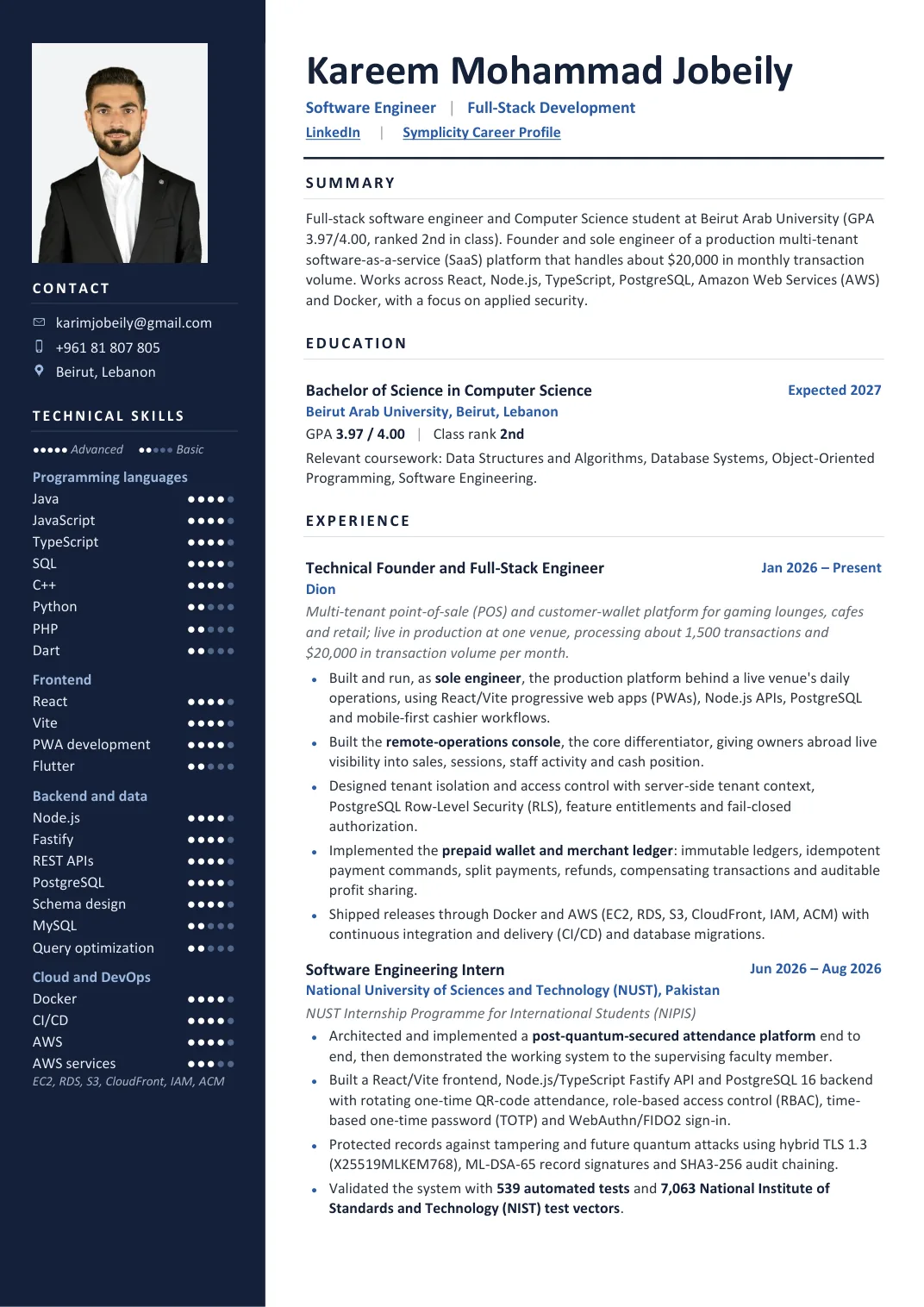
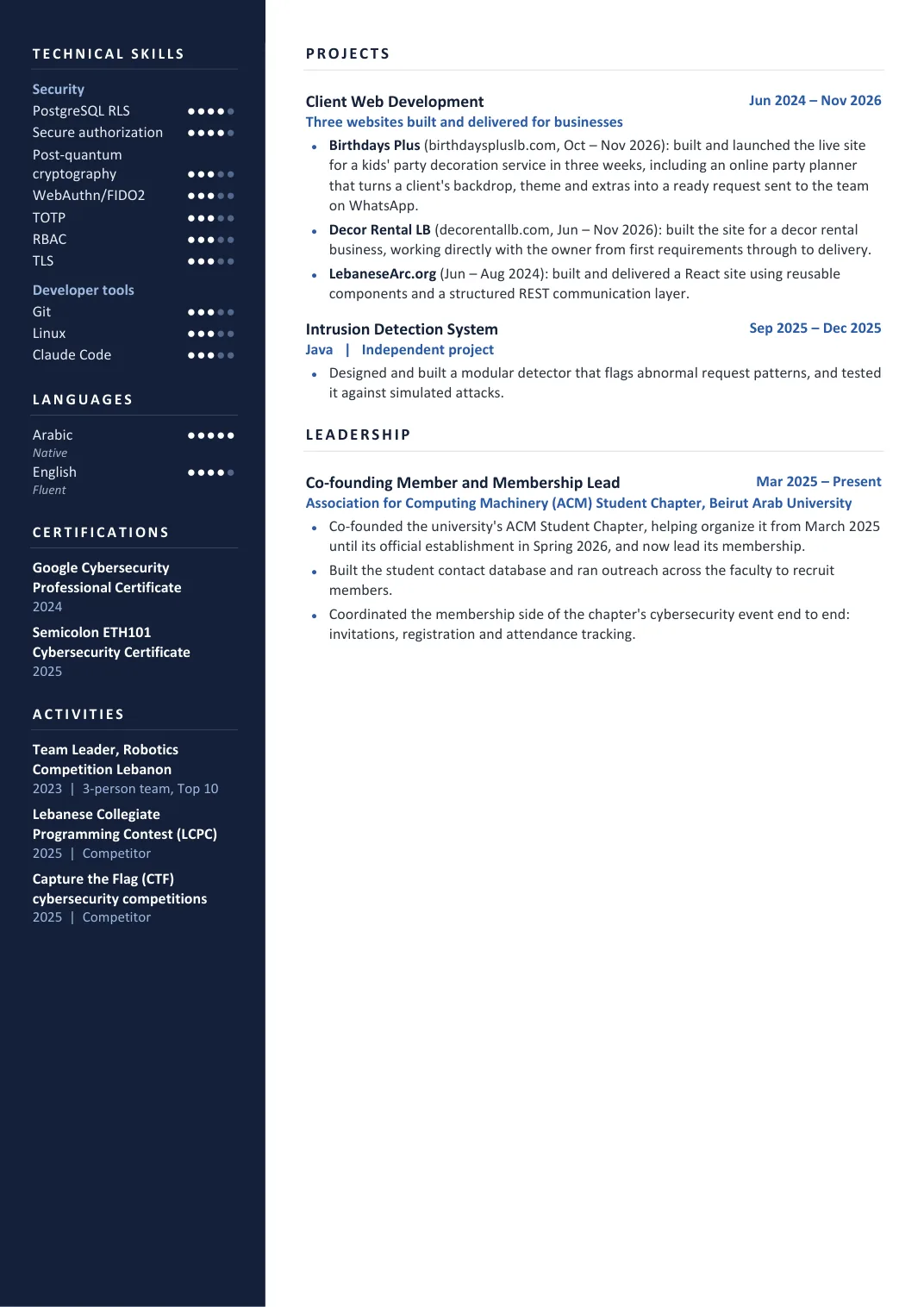
- My strongest assets are cloud and DevOps tools, backend development, and applied security. Where would these skills be helpful in this organization?
- Your AWS and Docker skills would help you deploy applications. Your backend experience would help you trace a problem from a Node.js service to its PostgreSQL database. Your knowledge of authentication and access control would also help you secure those services.
- Would you mind taking a look at my resume/CV?
- Keep it to one page and retain measurable results. Move AWS, Docker, CI/CD, and Linux higher in the skills section. Add your GitHub link, and include monitoring or infrastructure-as-code tools you have used.



 Have a role